
Diagnostic Perspectives on the Influence of Bhūtas (Elements) in Disease Manifestation
Dr A Sreenivasa Sarma
Assistant Professor
Division of Yoga Spirituality
S-VYASA University, Bangalore
Mobile:- 8500105150
mail:- sreenivasastro432@gmail.com
Abstract
The interrelationship of bhūtas (elements), doṣas, and guṇas forms the foundation of both medical diagnosis and Astrological diagnosis. This study explores how planetary placements and rāśis (zodiac signs) reflect elemental dominance and antagonism, thereby influencing disease manifestation. The principle of Viruddha‑Bhūta (elemental antagonism) is examined as a key mechanism through which physiological imbalance arises, while Sāmya‑Bhūta (elemental sympathy) reinforces resilience. By analyzing the role of planets and signs in relation to their elemental matrices—Agni (Fire), Jala (Water), Vāyu (Air), and Pṛthvī (Earth)—the research demonstrates how hostile combinations trigger localized crises in specific organs, whereas harmonious combinations strengthen vitality. Case studies of horoscopes illustrate the diagnostic application of this framework.
Keywords
Bhūtas (Elements); Doṣas; Guṇas; Viruddha‑Bhūta (Elemental Antagonism); Sāmya‑Bhūta (Elemental Sympathy); Medical Astrology; Rāśis (Zodiac Signs); Planetary Influence; Drishti (Aspects); Diagnosis; Integrative Healing.
1. Introduction
The structural and functional integrity of the human organism is fundamentally rooted in the equilibrium of the Panchamahābhūtas (the five primordial elements: Pṛthivī, Jala, Tejas, Vāyu, and Ākāśa). In the classical traditions of Vedic astrology (Jyotiṣa) and ancient Indian medicine (Āyurveda), physiological homeostasis and pathological manifestations are governed by the dynamic interplay between cosmic entities—represented by planetary bodies (Grahas) and zodiac signs (Rāśis)—and these five elemental building blocks.
According to Maharishi Parasara in the Bṛhat Parāśara Horā Śāstra, the structural and psychological temperament (Prakṛti) of an individual, as well as the bodily luster (Chāyā), directly mirror the operational strength of these elements as mediated by planetary periods (Daśās). Maharishi Parasara introduces this profound knowledge as the foundation for identifying planetary operations and their physiological states:
When these elemental forces operate in harmony, they sustain life and vitality. However, when a planet is posited in a sign whose elemental nature is mutually antagonistic, an elemental dissonance occurs. This incongruence within a specific limb or bodily segment precipitates somatic and psychological diseases. This paper provides a comprehensive diagnostic framework analysing how planetary strengths, elemental characteristics, sign orientations, and sensory mappings converge to influence health and dictate disease manifestation.
2. Taxonomic Mapping of Elements, Planets, and Senses
To establish a rigorous diagnostic methodology, one must map the macrocosmic forces (Grahas) to the microcosmic elements (Bhūtas) and their respective sensory faculties (Indriyas). This overarching cosmic-somatic link is defined by the following canonical rule:
शिखि भूखाम्बुवातानामधिपा मंगलादयः ।
तत्तद्दलवशाज्ज्ञेयं तत्तद्भूतभवं फलम् ।।[1]
The planets Mars, Mercury, Jupiter, Venus, and Saturn rule Fire, Earth, Ether (sky), Water, and Air respectively. The effects born of these elements must be discerned based on their respective strengths.
From a diagnostic perspective, the weakness or affliction of a specific planet directly compromises its corresponding Bhūta, thereby manifesting functional or structural pathology in the associated Indriya. For example, chronic afflictions to Saturn can lead to dermatological conditions or tactile neurological deficits via the Vāyu element, whereas a severely debilitated Sun or Mars degrades the Tejas element, impairing visual acuity. The structured mapping between sense organs, mahabhutas, and planetary rulers is formalized in the reference matrix below:
| Sense Organ (Indriya) | Element (Mahābhūta) | Ruling Planets (Grahas) |
| Eyes (Cakṣu) | Tejas (Fire) | Sun (Sūrya), Mars (Maṅgala) |
| Ear (Śrotra) | Ākāśa (Ether) | Jupiter (Guru) |
| Nose (Ghrāṇa) | Pṛthivī (Earth) | Mercury (Budha) |
| Tongue (Rasanā) | Jala (Water) | Moon (Candra), Venus (Śukra) |
| Skin (Tvak) | Vāyu (Air) | Saturn (Śani) |
3. Planetary Strengths and Constitutional Temperaments (Prakṛti)
The psycho-somatic constitution or temperament (Prakṛti) of an individual is dictated by the dominant planet at the time of birth, which projects its specific elemental nature upon the native. The foundational rules are outlined below:
सबले मंगले वहिस्वभावो जायते नरः ।
बुधे महीस्वभावः सयादाकाशप्रकृतिर्गुरौ ।।[2]
शुक्रे जलस्वभावश्च मारतप्रकृतिः शनौ ।
मिचैर्मिश्रस्वभावश्च विज्ञेयो द्विजसत्तम।।[3]
The native whose Mars is strong will have a fiery temperament. If Mercury is strong, the earthy temperament will be predominant. With strong Jupiter, he will acquire an ethereal temperament. His nature will be watery if Venus is strong, and the temperament of air will be more pronounced should Saturn be strong. If planets are mixed, a mixed temperament should be understood.
The explicit physiological and psychological characteristics of these elemental temperaments when active and healthy are detailed as follows:
Fiery Temperament (Agni/Pitta Prakṛti)
क्षुधार्तश्चपलः शूरः कृशः प्राज्ञोऽतिभक्षणः ।
तीक्श्णो गौरतनुर्मानी वहिप्रकृतिको नरः ।।[4]
A person with a predominant Fiery Tatwa will be hunger-stricken (having a strong appetite), very active, valorous, have a thin physique, be learned, a voracious eater, quite sharp, fair in complexion, and possess an overbearing or dominating nature.
Earthy Temperament (Māhī/Pṛthivī Prakṛti)
कर्पूरोत्पलगन्धान्यो भोगी स्थिरसुखी बली।
क्षमावान् सिंहनादश्च महीप्रकृतिको नरः ।।[5]
A person with a predominant Earthy Tatwa will emit the fragrance of camphor and lotus, enjoy copious luxuries, always remain happy and comfortable, be powerful, forgiving, and have a roaring voice akin to a lion.
Watery Temperament (Jala/Kapha Prakṛti)
कान्तिमान् भारवाही च प्रियवाक् पृथिवीपतिः।
बहुमित्रो मृदुर्विद्वान् जलप्रकृतिसम्भवः ।।[6]
A person with a predominant Watery Tatwa has a radiant personality, is capable of taking on the burdens of friends and relatives, is polite in nature, royal, possesses a good number of friends, and is soft and learned.
Airy Temperament (Māruṭa/Vāyu Prakṛti)
वायुतत्त्वाधिको दाता क्रोधी गौरोग्टनप्रियः।
भूपतिश्च दुराधर्षः, कृशांगो जायते जनः ।।[7]
A person with a predominant Airy Tatwa is charitable, easily angered, fair in complexion, loves traveling, is royal, hard to win, and possesses a thin, slender structure.
4. Diagnostics of Bodily Luster (Chāyā) and Elemental Daśās
A core diagnostic axiom relies on observing the changing bodily luster (Chāyā) during the operational period (Daśā) of a planet. The Chāyā acts as a visible clinical indicator of the internal state of the Bhūtas, showing its dominance across the physical framework:
सूर्ये वहिस्वभावरच जलप्रकृतिको विधौ।
स्वदशायां ग्रहारछायां व्यंजयन्ति स्वभूतजाम्।।[8]
Translation: If the Sun becomes strong, it will give a fiery nature, and in case the Moon is getting stronger, the native will acquire a watery nature. During the Dasa (period) of a particular planet, it will show the predominance of its element (Tatwa) from the brilliance (lustre) of the body.
4. Positive Signatures of Elemental Luster
When planets governing specific Bhūtas are structurally sound, well-placed, and active in their Daśā, they project highly favorable physiological and psychological markers:
- Fiery Luster (Vahni-chāyā): The physical body exhibits a golden, healthy radiance. The gaze is clear, warm, and pure. The individual achieves unhindered success in undertakings, conquers adversarial conditions, and acquires material prosperity.
स्वर्णदीप्तिः शुभा दृष्टिः सर्वकार्यार्थसिद्धिता।
विजयो धनलाभश्च वहिभायां प्रजायते ।।[9]
When there is a rise of fiery Tatwa, the person shines like gold, his eyes shower purity (love, warmth), and he achieves success in all pursuits, emerging a conqueror and acquiring good wealth.
Earthy Luster (Bhūmi-chāyā): The body exudes an inherently agreeable aroma. The nails, teeth, and hair appear exceptionally clean, smooth, and nourished. The mind inclines toward righteousness (Dharma), bringing deep joy and stable wealth.
इष्टगन्धः शरीरे स्यात् सुस्निग्धनखदन्तता ।
धर्मार्थसुखलाभश्च भूमिच्छाया यदा भवेत् ।।[10]
When there is a rise of earthy Tatwa, the body of the person will emit a likable fragrance; he possesses neat nails, hair, and teeth. He is religious and is bestowed with wealth and happiness .
Watery Luster (Jala-chāyā): Characterized by an innate physical softness, structural grace, and robust constitutional health. The physiological functions operate with optimal taste and digestion, preserving systemic contentment.
मृदुता स्वस्थता देहे जलच्छाया यदा भवेत् ।
तदाऽभीष्टरसस्वादसुखं भवति देहिनः ।।[11]
When there is a rise of watery Tatwa, the person will be graceful and have sound health. On getting food of his own taste, he remains quite happy.
Pathological Manifestation: The Failure of the Airy Element
When a planet governing an element is weak, debilitated, or placed in an inimical sign, the contrary results (Viparītaṃ phalam) manifest immediately during its Daśā. The Bṛhat Parāśara Horā Śāstra highlights the unique diagnostic vulnerability of the Airy Luster (Vāyu-chāyā) when afflicted:
मालिन्यं मूढता दैन्यं रोगाश्च पवनोद्भवाः ।
तदा च शोकसन्तापी वायुच्छाया यदा भवेत् ।।[12]
When the airy Tatwa rises in an afflicted or negative state, the person becomes dirty, foolish, struck with poverty, contracts air-borne diseases (such as rheumatism), and faces sorrows and agonies.
The kind of results stated over here should be predicted by the learned only on the basis of the strength of the planets i.e., Mars etc. If these planets happen to be weak, contrary results of the Tatwa should be stated.
एवं फलं बुधैयं सबलेषु कुजादिषु ।
निर्बलेषु तथा तेषु वक्तव्यं व्यत्ययाद् द्विज।।[13]
Furthermore, under the structural debility of planets being in debilitation or inimical signs, the effects degrade completely:
नीचशत्रुभगैश्चापि विपरीतं फलं वदेत् ।
फलाप्तिरबलैः खेटः स्वप्नचिन्तासु जायते ।।[14]
In the event of planets being in their debilitation or inimical sign, the contrary results of the Tatwa will take place. If they are entirely bereft of strength, the effect of the tatwa will be imaginary, which one may only dream of.
5. The Role of Rāśis
In Jyotiṣa, the twelve Rāśis (zodiacal signs) function as subtle fields through which the planetary forces express themselves. While Grahas represent the active agents influencing health and disease, the Rāśis provide the environmental and constitutional framework in which these influences manifest. Each Rāśi is characterized by a specific Bhūta (element) and Guṇa (Sattva, Rajas, or Tamas), which together reveal important physiological and psychological tendencies. Understanding these elemental and qualitative attributes enables the physician or astrologer to identify potential doṣic predispositions, constitutional vulnerabilities, and disease patterns. Thus, the Rāśis become valuable diagnostic indicators in assessing the manifestation of disease (roga-prakāśa) and health tendencies.
The elemental constitution (tattva-svabhāva) of a Rāśi reflects the predominance of one of the Mahābhūtas—Agni (fire), Pṛthvī (earth), Vāyu (air), or Jala (water). These elements correspond closely to the Ayurvedic understanding of bodily functions and pathological processes. Likewise, the predominance of Sattva, Rajas, or Tamas influences the mental and behavioural dimensions of health. Classical texts repeatedly emphasize that “Guṇāḥ prakṛti-sambhavāḥ”—the qualities arising from nature govern both bodily and psychological responses. Therefore, the combined study of Guṇa and Tattva in the Rāśis offers an important framework for understanding disease susceptibility.
Sage Parāśara in his Bṛhat Parāśara Horā Śāstra clearly explains____ the inherent qualities of each zodiac sign, describing their complexion, constitution, temperament, and elemental dominance. For example, regarding Aries he states:
“पूर्ववासी नृपज्ञातिः शिः शैलचारी रजोगुणी ।
पृष्ठोदयी पावकी च मेषराकुजाधिपः ॥[15]
Translation: The sign Aries has a blood‑red complexion, a bulky body, is quadruped, strong at night, resides in the east, belongs to the royal caste, wanders in the hills, is dominated by Rajo‑guṇa, rises with its back (Pṛṣṭhodaya), is fiery in nature, and is ruled by Mars.
In the same way, each sign is described with its elemental foundation (Agni, Jala, Vāyu, Pṛthvī), its guṇic predominance (Sattva, Rajas, Tamas), and its natural qualities. By observing all twelve signs collectively, we see a systematic compilation of the nature of signs according to their elemental division.
“The descriptions of the signs, their qualities, and elemental dominations are clearly explained by Sage Parāśara in the Bṛhat Parāśara Horā Śāstra, Chapter 5, Ślokas 6 to 24.”
The Fiery signs—Aries (Meṣa), Leo (Siṃha), and Sagittarius (Dhanuṣ)—are associated with Agni Tattva, representing metabolism, vitality, transformation, and heat. Aries is described as Rajoguṇī Pāvakī, indicating a dynamic and action-oriented temperament. Excessive fire in such signs may predispose individuals to inflammatory disorders, febrile conditions, hyperacidity, hypertension, headaches, and impulsive behaviour. Leo, being Sattvī and ruled by the Sun, directs fiery energy toward leadership, courage, and strong vitality; however, afflictions may manifest as cardiovascular stress, excessive heat disorders, or ego-related psychological disturbances. Sagittarius combines Agni Tattva with Sattva Guṇa, promoting idealism, wisdom, and enthusiasm. Yet, imbalance may produce excessive ambition, liver dysfunctions, inflammatory diseases, or disorders arising from overexertion. Collectively, Agni-dominant signs often show a tendency toward Pitta aggravation, characterized by heat, inflammation, and heightened metabolic activity.
The Earthy signs—Taurus (Vṛṣabha) and Capricorn (Makara)—are dominated by Pṛthvī Tattva, representing stability, structure, nourishment, and endurance. Taurus, being Rajoguṇī, combines material productivity with persistence and sensory attachment. Physiologically, it supports tissue development and bodily strength; however, excessive earth influence may contribute to obesity, glandular disorders, congestion, metabolic sluggishness, and Kapha-related conditions. Capricorn, characterized by Tamo Guṇa and Earth element, exhibits endurance, discipline, and resilience, but when afflicted may predispose to chronic diseases, degenerative disorders, skeletal problems, stiffness, and conditions marked by obstruction or delayed recovery. The predominance of Earth element generally indicates a tendency toward Kapha-related disorders, where accumulation, heaviness, and stagnation become prominent pathological features.
The Airy signs—Gemini (Mithuna), Virgo (Kanyā), and Aquarius (Kumbha)—are governed by Vāyu Tattva, which signifies movement, communication, nervous activity, and sensory responsiveness. Gemini is described as Anilī (airy) and possesses an active, adaptable, and intellectually curious nature. Excessive Vāyu may manifest as anxiety, nervous disorders, respiratory ailments, insomnia, and instability of mind. Virgo combines Vāyu Tattva with Tamo Guṇa, creating an analytical yet often worry-prone disposition. Such individuals may be susceptible to digestive irregularities, psychosomatic disorders, intestinal disturbances, and excessive mental stress. Aquarius, another Vāyu sign influenced by Tamas, often reflects unconventional thinking and deep contemplation; however, imbalance may lead to circulatory disturbances, neurological disorders, chronic anxiety, or social detachment. In Ayurvedic terms, Vāyu-dominant signs commonly indicate susceptibility to Vāta disorders, characterized by irregularity, dryness, degeneration, and nervous dysfunction.
The watery signs—Cancer (Karkaṭa), Scorpio (Vṛścika), and Pisces (Mīna)—are associated with Jala Tattva, which governs emotional sensitivity, nourishment, cohesion, and fluid balance. Cancer is explicitly described as Sattvaguṇī Jalī, reflecting emotional receptivity, nurturing qualities, and psychological sensitivity. Disturbances may manifest as oedema, digestive weakness, lymphatic disorders, or emotional fluctuations. Scorpio, though traditionally associated with water, possesses intense transformative energy due to the rulership of Mars. Its psychological nature often expresses secrecy, passion, and emotional depth; affliction may result in reproductive disorders, toxic accumulations, inflammatory conditions, or obsessive tendencies. Pisces, endowed with Sattva Guṇa and Water element, promotes compassion, intuition, and spiritual inclination. However, excessive watery influence may contribute to fluid retention, endocrine imbalance, escapist tendencies, emotional vulnerability, or psychosomatic disorders. Collectively, Jala signs frequently indicate a predisposition toward Kapha-related conditions and disorders involving bodily fluids, while also highlighting strong emotional influences on health.
From the perspective of the three Guṇas, the signs reveal distinct psychological constitutions. Sāttvika signs—Cancer, Leo, Sagittarius, and Pisces—promote mental clarity, emotional balance, wisdom, and resilience. Individuals influenced by these signs generally possess stronger psychological adaptability and better recovery capacity. Rājasic signs—Aries, Taurus, and Libra—are characterized by activity, ambition, passion, and outward engagement. While these qualities support achievement and dynamism, excessive Rajas may lead to stress-related disorders, emotional agitation, hypertension, and impulsive decision-making. Tāmasic signs—Virgo, Capricorn, and Aquarius—tend toward inertia, persistence, introspection, and concealment. When balanced, these qualities provide stability and endurance; however, excessive Tamas may manifest as chronic diseases, depression, lethargy, obstruction, and delayed healing processes.
Therefore, the diagnostic significance of the Rāśis lies in their ability to reveal the interaction between Bhūta, Guṇa, and Doṣa. The predominance of Agni suggests Pitta-oriented pathology; Pṛthvī and Jala indicate Kapha tendencies; while Vāyu points toward Vāta predominance. Simultaneously, the Guṇas provide insight into the psychological environment in which disease develops. As implied in the classical understanding of “Yathā piṇḍe tathā brahmāṇḍe” (the microcosm reflects the macrocosm), the elemental and qualitative nature of the Rāśis mirrors both bodily constitution and disease expression. Consequently, analysis of the Rāśis offers a valuable complementary approach for understanding susceptibility to specific disorders, progression of disease, and individualized health assessment.
Table: Rāśis, Guṇas, Elements, and Diagnostic Indications
| Rāśi (Sign) | Guṇa | Bhūta | Likely Doṣa Predominance |
| Aries (Meṣa) | Rajas | Agni | Pitta |
| Taurus (Vṛṣabha) | Rajas | Pṛthvī | Kapha |
| Gemini (Mithuna) | Rajas | Vāyu | Vāta |
| Cancer (Karkaṭa) | Sattva | Jala | Kapha |
| Leo (Siṃha) | Sattva | Agni | Pitta |
| Virgo (Kanyā) | Tamas | Pṛthvī | Vāta |
| Libra (Tulā) | Rajas | Vāyu | Vāta-Pitta |
| Scorpio (Vṛścika) | Rajas | Jala | Pitta-Kapha |
| Sagittarius (Dhanuṣ) | Sattva | Agni | Pitta |
| Capricorn (Makara) | Tamas | Pṛthvī | Kapha-Vāta |
| Aquarius (Kumbha) | Tamas | Vāyu | Vāta |
| Pisces (Mīna) | Sattva | Jala | Kapha |
6. The Principle of Elemental Antagonism (Viruddha-Bhūta)
The primary mechanism of disease generation in Vedic therapeutics rests upon the structural law of elemental compatibility. As preserved in the commentary tradition of Krṛṣṇīyam and expanded by Rudra Bhaṭṭa:
“तत्र यस्मिन्नङ्गे विरुद्ध– भूतैक्यं सम्भवति तत्र तथाविधो रोगो वाच्यः”!![16]
In whatever limb or bodily segment, the combination of mutually opposed and antagonistic elements occurs, precisely within that location must the development of disease be predicted.”
This principle asserts that when a planet is posited within a sign whose elemental foundation is hostile to its own, a localized tissue crisis arises. Conversely, when a planet occupies a sign sharing an identical or cooperative elemental matrix, the associated organ or limb is reinforced, showing enhanced physiological resilience.
Max Heindel’s Perspective
In astrology the trine is considered harmonious and benefice. Then we have the signs which represent the four elements, forming the fiery, earthy, airy, and watery triangles. The fiery and airy signs are in harmony with each other, and the earthy and watery triplicities are friendly; but the fiery and watery will not harmonize, neither will the earthy and the fiery signs. Planets in these various groups of signs will express the same sympathy or antipathy as the signs themselves. The sign triplicities express themselves through harmony in the temperaments and personalities of people, while the squares express their afflictions through physical discomforts.
This framework aligns closely with the Vedic principle of Viruddha‑Bhūta, where elemental clashes generate vulnerability, and elemental harmony reinforces resilience, showing that both traditions recognize the profound influence of elemental compatibility on human well‑being.
Elemental Relationships
- Sympathetic Pairings (Sāmya‑Bhūta):
- Fire + Air → cooperative, reinforcing vitality
- Water + Earth → stabilizing, nourishing
- Antagonistic Pairings (Viruddha‑Bhūta):
- Fire vs. Water → inflammation, fluid imbalance
- Air vs. Earth → instability, rigidity, nervous strain
Illustrative Examples
Antagonism
Moon (Water/Jala) in Aries (Fire/Agni): → Antagonism. Emotional fluids clash with fiery temperament. This may manifest as gastric inflammation, fevers, or emotional volatility affecting the head region.
Mars (Fire/Agni) in Capricorn (Earth/Pṛthvī): → Antagonism. Fire disrupts Earth’s stability, leading to joint inflammation or bone weakness.
Venus (Water/Jala) in Leo (Fire/Agni): → Antagonism. Reproductive tissues clash with fiery heart energy, leading to cardiac stress or hormonal imbalance.
Moon (Water/Jala) in Cancer (Water/Jala): → Sympathy. Emotional stability and fluid balance are reinforced.
Sympathy
- Sun (Fire/Agni) in Sagittarius (Fire/Agni): → Strong vitality, cardiovascular resilience.
- Jupiter (Fire/Agni) in Leo (Fire/Agni): → Enhanced immunity, leadership strength.
- Mercury (Air/Vāyu) in Gemini (Air/Vāyu): → Nervous system endurance, intellectual sharpness.
- Moon (Water/Jala) in Cancer (Water/Jala): → Emotional stability, fluid balance.
Sympathetic Organs: Disease in one organ may originate in another that shares elemental sympathy (e.g., lungs ↔ kidneys, both Air signs).
7. Horoscope Example 1: – Gynaecological issue
In this horoscope, the onset and progression of disease can be traced through the principle of Viruddha‑Bhūta (elemental antagonism) and the role of afflicted houses. The lady suffered from cold and throat issues since childhood, which directly connects to the 6th house (Roga Sthāna). Here, Taurus governs the throat and neck region. Taurus is an earthy sign, yet the Sun—a fiery planet—is positioned here, while its lord Venus, a watery planet, is placed in Gemini, an airy sign. This combination reflects a lack of elemental sympathy, producing vulnerability in the throat and respiratory system. The 2nd house, which also governs the throat, is further afflicted: its lord Saturn is placed in Cancer, an enemy house, where an airy planet is caught in a watery sign. This again shows antagonism, reinforcing chronic throat disorders.
Two decades after marriage, a severe blood clot developed on her spine. The spinal region is governed by Sagittarius, a fiery sign. Within this sign, Moon (watery) and Rahu are positioned, creating elemental antagonism against fire. The lord of Sagittarius, Jupiter, is also in a fiery sign, amplifying heat and inflammation. This fiery‑watery clash manifested as a clot in the spinal region, leading to unbearable pain and eventual surgical removal.
Following this, a grave gynaecological issue arose, culminating in the removal of her uterus. The 8th house, which governs reproductive organs and chronic disease, is Cancer—a watery sign. Saturn is positioned here in its enemy house, again reflecting antagonism. The 8th house signifies death and transformation, and its elemental imbalance directly impacted the reproductive system. Furthermore, the 8th sign Scorpio lies in the 12th house from the ascendant. The 12th house signifies loss, and here the loss of an organ—the uterus—occurred. The lord of Scorpio, a fiery planet, is placed in Pisces, a watery sign, producing Viruddha‑Bhūta and sealing the outcome of organ removal.
Thus, the progression of disease in this chart—from throat disorders to spinal clot and finally uterine loss—demonstrates how anti‑elemental combinations (Viruddha‑Bhūta) repeatedly afflicted the native. Each stage of illness corresponds to a house or sign where antagonistic planetary placements disrupted harmony, showing vividly how elemental imbalance manifests as disease in astrological diagnosis.
Interpretation: –
This chart demonstrates how anti‑elemental combinations (Viruddha‑Bhūta) repeatedly afflicted the native:
- 6th house Taurus (Earth) with Sun (Fire) + Venus (Water in Air) → throat and cold issues.
- 2nd house Saturn in Cancer (Air in Water) → chronic throat vulnerability.
- Sagittarius (Fire) with Moon (Water) + Rahu → spinal clot due to fiery–watery clash.
- 8th house Cancer with Saturn (enemy placement) → gynecological crisis.
- Scorpio (8th sign) in 12th house, lord in Pisces (Fire in Water) → loss of uterus through elemental antagonism
Horoscope Example 2: – Brain Fever
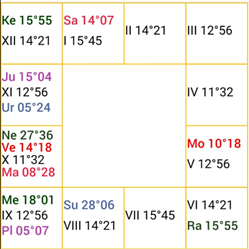
In this horoscope, the Lagna is Aries, which governs the head region. Saturn is placed in Aries, its nīca sthāna (debilitation), thereby afflicting both the ascendant and the sign of the head. This establishes the foundation for disease in the cranial region.
The origin of the illness is clearly rooted in anti‑elemental combinations. The Moon, a watery planet, is placed in Simha (Leo), a fiery sign, creating a direct clash of Jala and Agni. Simultaneously, the Sun is positioned in the 8th house (Vrishchika/Scorpio), a watery sign. This fiery–watery antagonism manifests as severe imbalance in the body, producing fever and neurological disturbance. The 8th house, being Maraṇa Sthāna, signifies danger to life, and the elemental conflict here reduced the native’s chances of survival.
The presence of Rahu in the 6th house (Roga Sthāna) further intensified the condition. Rahu is notorious for producing unknown, mysterious, and severe diseases, and here it amplified the affliction, making the fever life‑threatening.
However, Guru’s drishti (Jupiter’s aspect) on both Saturn and Moon provided a protective influence, enabling recovery and healing despite the severity of the disease. Jupiter’s benefic fire reinforced resilience and counterbalanced the antagonism.
Later in life, the native also suffered from gynecological and excretory organ issues. These complications are explained by the continued antagonism between Sun and Moon placements—fire and water in hostile positions—affecting reproductive and eliminatory systems.
Interpretation: –
This case demonstrates how Viruddha‑Bhūta (elemental antagonism) manifests in disease:
Saturn debilitated in Aries → affliction of head and Lagna.
Moon in Leo (fire) + Sun in Scorpio (water) → fiery–watery clash, producing brain fever.
Rahu in 6th house → mysterious, severe disease.
Jupiter’s aspect → healing influence, preventing fatality.
Later gynecological/excretory issues → continued impact of fire–water antagonism in sensitive houses.
8 Conclusion
The principle of Viruddha‑Bhūta (elemental antagonism) demonstrates that disease is not random but arises from deep structural conflicts between planetary energies and elemental foundations. When planets occupy signs hostile to their own elemental nature, localized crises manifest in the organs and tissues governed by those houses. Conversely, sympathetic elemental combinations reinforce resilience and vitality.
This framework is not merely theoretical—it provides a diagnostic lens that complements Āyurveda. In Āyurveda, disease is understood through the imbalance of doṣas (Vāta, Pitta, Kapha), which themselves are rooted in the pañca‑bhūtas (Agni, Jala, Vāyu, Pṛthvī, Ākāśa). Each doṣa is a functional expression of elemental combinations: Vāta arises from Air and Ether, Pitta from Fire and Water, and Kapha from Water and Earth. These, in turn, are colored by the guṇas (Sattva, Rajas, Tamas), which shape the psychological and spiritual dimension of health.
Moreover, the element theory that underlies this principle is also the foundation of Naturopathy, which emphasizes harmony between the body and nature’s elements—earth, water, fire, and air. By integrating astrological diagnosis with Ayurvedic and naturopathic principles, practitioners gain a powerful tool for both identifying vulnerabilities and guiding therapeutic interventions.
Thus, the study of Viruddha‑Bhūta is not only academically enriching but also practically invaluable. It bridges ancient wisdom with modern holistic therapies, offering a comprehensive approach to diagnosis and healing that can transform medical astrology into a meaningful ally of integrative health sciences.
References
- Bṛhat Parāśara Horā Śāstra – Sage Parāśara; Translation by Girish Chand Sharma; Digital Library of India, JaiGyan Edition, Volumes 1 & 2; Publisher: JaiGyan Publications, Location: India; Chapter 5, Ślokas 6–12; Edition: Critical Edition; Year: Classical text (digital reprint).
- Astro‑Diagnosis: A Guide to Healing – Max Heindel; Publisher: The Rosicrucian Fellowship, Location: Oceanside, California, USA; Edition: First Edition; Year: 1929.
- Approach and Update to Astrology in Āyurveda – Dr. Waghe; Publisher: Rāṣṭra Gaurav Publications, Location: Nagpur, India; Edition: First Edition; Year: 2022.
[1] B.P.H-78/2
[2] B.P.H-78/3
[3] B.P.H-78/4
[4] B.P.H-78/6
[5] B.P.H-78/8
[6] B.P.H-78/9
[7] B.P.H-78/10
[8] B.P.H-78/5
[9] B.P.H-78/11
[10] B.P.H-78/12
[11] B.P.H-78/14
[12] B.P.H-78/14
[13] B.P.H-78/16
[14] B.P.H-78/17
[15] B.P.H-5/6
[16] B.P.H-4/14 commentary.