
“Vedic Geometry and Sulba Sutras – The Indian Contribution to Applied Mathematics and Architectural Science”
Ms. Shravani BN
Department of Sanskrit and Vedic Studies
Sri Sathya Sai University for Human Excellence,
Kalaburagi.
Abstract
This paper discusses the Vedic Geometry mentioned in the Sulba Sutras, which were the earliest works on applied geometry, even before Euclidean geometry came into being. This paper discusses geometry concepts used for building Vedic fire altars called ‘Yagna Kunda’, old units of measurement, squaring of circles, and the Baudhayana Theorem related to the Pythagoras Theorem.
Keywords
Vedic Geometry, Sulbasutra, Baudhayana Theorem, Yagna Kunda.
Objectives
1. To investigate the origin of Vedic Geometry through four Indian subjects namely Kalpa, Jyotisha, Shilpa Shastra, and Srividya.
2. To study the Sulba Sutras in the perspective of the world’s earliest application of geometry by specifically looking into the Baudhayana Sulba Sutra.
3. To show the highly developed knowledge of geometry involved in the creation of Tretha Agni / Chitis through accurate measurement and arrangement of bricks according to different shapes.
4. To explain how Maharishi Baudhayana described the Pythagorean Theorem centuries ahead of Pythagoras in a historical perspective.
5. To present some techniques used in Vedic Geometry like squaring a circle and establishing the cardinal directions based on the shadows of ropes as depicted in the Sulba Sutras.
1.Introduction
Ancient Indian Geometry Temples have been the pride of Indian culture and heritage for many millennia, and with their magnificent sculptures, architectural designs, and symmetrical structures, the question that springs up is: how much knowledge about geometry did the architects of these ancient temples possess, thousands of years back, when there were no measuring instruments, compasses, or scales available?
The question above prompts us to think of the one most neglected chapter in the history of mathematics which has been labelled as “Vedic Geometry.” The term encompasses the vast domain of knowledge about mathematics and geometry that ancient Indian texts contain, not as part of mythology, but as an empirical and applied science, having great influence on the field of astronomy and architecture, among others.
2. Sources of Vedic Geometry
The sources of Vedic geometry can be traced through four main disciplines of ancient Indian science, namely:
1. Kalpa (Sulba Sutras): The rule of Yagnam (fire rites in Vedas), that contains detailed geometric instructions to make fire altars of different forms and same areas.
2. Jyotisha (Astronomy): The science of heavenly bodies which required advanced knowledge of geometry, trigonometry, and calculus to calculate the exact position of planets.
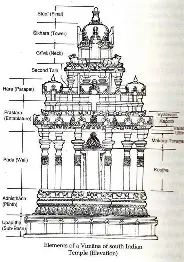
3. Shilpa Shastra: The science of building temples and making sculptures including architecture and metallurgy.
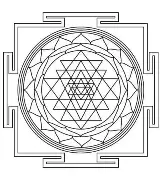
4. Srividya: A specific form of worship which includes construction of geometrical diagrams called ‘Yantras’.
Jyotisha

Kalpa

Shilpa Shastra
Srividya
This study focuses primarily on the Kalpa sutras, particularly the sulbha sutras.
Kalpa is the code of yagnam. It has two parts:
1. Sulbha sutras (rules for logistics of yagnyam)
2. Srauta sutras (rules for performance of yagnam)
3. The Sulba Sutras: World’s Oldest Applied Geometry
The Sulba Sutras (Sulabha-Rope, Sutra-Principle), literally “principles of the rope,” are part of a collection of texts within Kalpa containing mathematical guidelines crucial for building the fire altars (Yagna Kunda’s or Chitis) for the Yagnas prescribed by the Vedas. The Sulba Sutras are referred to as “the world’s oldest applied geometry,” which preceded Euclidean geometry (300 BCE).
Since there were no advanced measuring devices, their geometric techniques were basic yet extremely accurate.


The ritual performance of yagnum is also a very old tradition, although the origins of which cannot be identified, but which has been prevalent in India all along. You could pick up any ancient text on Indian scriptures, and you would not find anything that does not pertain to the subject of Yagnyam.
3.1 Tretha Agni
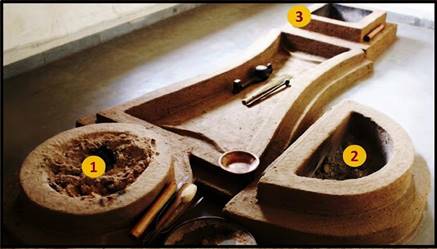
These altars of fire are called Tretha Agni.
Meaning: The term Trethagni means the “Triad of Sacred Fires” that is tended by a priest who follows the teachings of Vedas (Agnihotri). According to Vedas, the three sacred fires belong to separate cosmic planes and have their own ritualistic functions.
1. Garhapatya (गार्हपत्य)
The name Garhapatya means the “Householder’s Fire.” It is round in shape and requires perpetual burning. Historically, the Garhapatya was located in the western region of the sacrificial enclosure. It is an emblem of the earth plane and perpetuation of generations. All other fires are traditionally lit from the Garhapatya fire.
2. Dakshinagni (दक्षिणाग्नि)
This is the “Southern Fire,” also referred to as Anvaharyapachana. It is half-round or bow-shaped and positioned on the south side. The Dakshinagni fire is mainly used for the Pitru rites and protects from evil spirits coming from the southern region.
3. Ahavaniya (आहवनीय)
This fire is also known as the “Fire of Invocation” or the “Offering Fire.” This fire is in the form of a square and is placed in the eastern direction. It represents the mouth of the gods; all the offerings of ghee and grains are offered here to reach the skies. This fire represents the sky/heavens.
Connection with the Symbolism
These three fires are jointly referred to as the Vaitanika Agni in Sanskrit language. These fires represent the three planes:
• Garhapatya = Prithvi
• Dakshinagni = Antariksha
• Ahavaniya = Dyuloka
Many years ago, the idea of geometry was completely different; then how did the
Indians and Russians compute the area of such fire altars many years ago? Let us understand the ideas about measurement. The first concept to consider here is the idea of units of measurement. Then, what was the unit of measurement?
3.2 Ancient Vedic Measurement Unit – ANGULA

1 The distance between the ends of 34 seasame grains is 1 Angula
2 The oldest known oil-seed crop.
As per the teachings provided in the sutras, the process is as follows:
1. Insert a long stick into the ground and tie a rope to it. Draw a circle around the stick by pulling the rope just before sunrise.
2. The shadow cast from the top of the stick will intersect the circle drawn in step one twice, once on rising and once on setting. These points mark the East-West line.
3. Consider this line as the base and use ropes to create four circles of equal radius, taking into consideration that the intersections created by each rope will be important.
4. These intersections will be marked as points A, B, C, and D, which will represent the corners of a square.

The process is entirely geometrical and can be performed using just sticks and ropes and observation of the sun’s rays.
3.3 Squaring the Circle (Without Pi)
One of the most amazing postulates presented in the Sulba Sutras is the technique for constructing a circle of equal area to a given square, something that would appear to require knowledge of Pi, which was not yet known.
As per the sutras, the construction would go as follows:
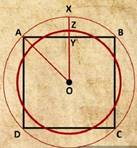
1. First, draw a square ABCD and locate its center at O.
2. Then extend the diagonal to the points X and Y.
3. Next, divide XY into three equal segments and locate point Z, such that YZ = (1/3) XY.
4. Finally, construct a circle with radius OZ.
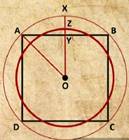
This circle will have the same area as the original square, an assumption that can easily be confirmed using geometry till today. This is indeed a tribute to the brilliance of the Vedic mathematicians.
3.4 The Shapes of Yagnya (Chitti)
The shape of the fire-altar used in Vedic rituals was not a fixed one; it was different according to the purpose of the ritual.
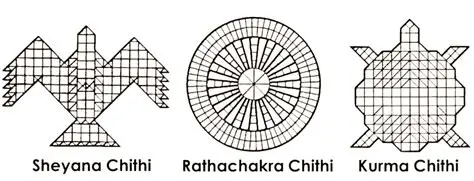
– A falcon-shaped Chiti (Sheyana Chithi) was made to earn prosperity.
– A triangle or rhombus-shaped Chithi was used to defeat the enemy in the war.
– A hemisphere-shaped Chiti was made to pray for food and prosperity.
In this regard, it should be noted that these Chitis were not made of mud but were made by assembling precisely baked bricks in various geometrical figures such as squares, rectangles, triangles, rhombi, and trapezoids all fitted together to form the required shape.
The Shayna Chithi (falcon-shaped)
Gometry beyond to cut the bricks: There are many sutras mentioned in sulbha sutras.
Example: दीर्घचतुरश्रस्याक्ष्णया रज्जु: पार्श्वमानी तिर्यग्
मानी च यत् पृथग् भूते कुरुतस्तदुभयं करोति ॥
“dīrghacaturaśrasyākṣṇayā rajjuḥ pārśvamānī tiryaṅ
maniyacha yatra prthag bhavati kurutastadubhyam karoti”
– Chapter 1.12, Baudhayana Sutras, Kalpa, Yajur Vedam
Meaning
“A rope that is stretched from the diagonal of a square produces an area which the two sides of the rectangle produce jointly”
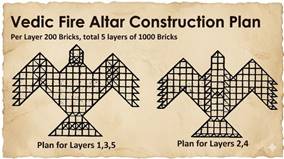
For instance,
• Exactly 5 layers were needed
• Exactly 200 bricks for each layer were required (total 1,000 bricks)
• Layers alternate in their shapes as odd and even
This mathematical precision, involving hundreds of precisely cut bricks in layers without any modern technology, highlights the amazing complexity of Sulba Sutra mathematics.

4. Maharishi Baudhayana: The Pythagorean Theorem
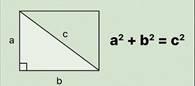
One of the most significant contributions from the Sulba Sutras is perhaps the famous Pythagorean Theorem, first mentioned hundreds of years prior to the time of Pythagoras by Maharishi Baudhayana.
“A rope stretched across the diagonal of a square produces an area double the size of the original square.”
Or in mathematical notation, a² + b² = c².
Conservative estimates of the period in which Maharishi Baudhayana lived indicate a date of around 800 BCE, while Pythagoras (circa 500 BCE) lived three hundred years later. Yet, it is difficult to determine exactly how old the Sulba Sutras themselves are, as their provenance lies in the Vedic practice of Yagnam, which has no known origins.
From a wider historical perspective, the same property (in terms of Pythagorean triplets) can be found in:
– Babylon (Plimpton 322 tablet) – estimated date ~1800 BC
– Egypt (Rhind papyrus) – estimated date ~1500 BC
– Greece (Pythagoras) – estimated date ~500 BC
The contribution of Baudhayana falls right within this timeline, and the Sulba Sutras not only describe the theorem but also its application in practice.
5. Conclusion
Sulba Sutras represent an amazing example of how advanced the field of mathematics was in ancient India. Without modern tools and mathematical language, Vedic mathematicians had already created sophisticated geometrical procedures to build highly irregular yet equally sized fire altars. The invention of the Pythagorean Theorem by Maharishi Baudhayana in the eighth century BCE, some three hundred years ahead of Pythagoras, demonstrates the profound mathematical research carried out by the Vedic people. From the ability to square the circle while lacking any information about Pi to building fire altars composed of a thousand bricks using geometry, Vedic geometry links spiritual ritualism with scientific calculations. Acknowledging its existence is crucial both for historical correctness and cultural understanding of mathematics’ global origins.
Reference
- The Science of the Sulba, Datta, B., Calcutta, India, University of Calcutta Press, Ch. 2: Geometric Constructions of the Fire Altars, pg. 45-78. 1st ed. 1932.
- The Crest of the Peacock, Joseph, G. G., Princeton, NJ, USA, Princeton University Press, Ch. 8: Indian Mathematics – The Vedic Period, pg. 227-260, 3rd ed. 2011
- History of Science in India, Vol. 1, Seidenberg, A.; Bag, A. K. & Sharma, S. R. (eds.), New Delhi, India, National Academy of Sciences India, Ch. 3: Sulba Sutras and Geometric Algebra, pg. 88-116, 1st ed. 1978
- Mathematics in India, Plofker, K., Princeton, NJ, USA, Princeton University Press, Ch. 2: Geometry in the Vedic Age, pg. 17-59, 1st ed. 2009.
- On the Sulvasutras, Thibaut, G., Calcutta, India, Asiatic Society of Bengal, Ch. 1: Baudhayana Sulabha Sutra – Rules and Applications, Pg. 1-52, 1st ed. 1875
- The Astronomical Code of the Rigveda, Kak, S., New Delhi, India, Munshiram Manoharlal Publishers, Ch. 5: Geometry, Astronomy, and Altur Constructions, Pg. 134- 162, 2nd ed. 2000