
Mastering the Mind: The Path to Manas Shanti through Vedantic and Yogic Disciplines.
Munesh S.
Postgraduate Student, M.A in Vedic Studies.
Contact: +91 6362019931 | E Mail – munesh.s@ssslsg.org |
Dr. Naveen Bhat, (HOD Dept. Sanskrit & Vedic Studies)
Sri Sathya Sai University for Human Excellence. Chikkaballapur, Muddenahalli,
1. AbstractThis paper explores attaining Manas Shanti through Vedantic and Yogic mastery of the Antahkarana (Manas, Buddhi, Ahankara, Chitta). By removing Mala, Vikshepa, and Avarana via Ashtanga Yoga, one achieves mental purity. We conclude that discipline, moderation, and surrender facilitate the permanent peace and self-consciousness necessary for ultimate Moksha.
2. Keywords
Nature of the Mind, Control of the Senses, Yoga Sutras of Patanjali, Ashtanga Yoga, Bhagavad Gita, Moderation, Brahmacharya, Vivekachudamani, Tapas, Spiritual Discipline, Liberation (Moksha)
The most important thing to master in life is to master one’s mind, as we can clearly see in The Bhagavad Gita that our whole life depends solely on our mind! Our mind can be a supporting pillar that enables us to live in happiness and peace; however, it can also become the pillar of destruction that takes away our peace of mind and gives us many other problems.[i]
In The Illustrated Light on Yoga by BKS Iyengar, in the section where the answer to the question “What is Yoga?” is provided, the answer is that “Yoga is the combination of the body, mind, and emotions, and when all three are in alignment, Yoga is experienced.” Therefore, through the practice of Yoga, we can Balance the Mind. Finally, the significance of the balance of the mind and the physical balance, as well as the control of the senses, is clearly highlighted in the Yoga Sutras by Patanjali.
4. Structure and Nature of the Mind
The mind operates through 4 distinct elements which include Manas, Buddhi, Ahamkara, and Chitta. [ii]Manas enables the mind to process thoughts while making decisions about what to accept or reject. Buddhi enables the intellect to evaluate situations by establishing what is right and what is wrong thereby assisting users in their decision-making process. Ahamkara functions as the ego which people use to develop their sense of identity while experiencing feelings of pride. Chitta functions as a storage system which keeps all memories, and all acquired mental patterns. The process of mind control requires complete command over all four mind functions. The Upanishads describe the mind as a system which operates like reins that guide horses throughout their journey.
The five senses operate in a manner similar to that of horses that run in pursuit of their own particular objects. The eyes run in pursuit of beautiful shapes, the ears run in pursuit of beautiful sounds, the tongue runs in pursuit of flavors, the skin runs in pursuit of sensations, and the nose runs in pursuit of scents.
This idea is beautifully expressed in Vivekachudamani by Adi Shankaracharya:
“शब्दादिभिः पञ्चभिरेव पञ्च पञ्चत्वमापुः स्वगुणेन बद्धाः ।
कुरङ्गमातङ्गपतङ्गमीन भृङ्गा नरः पञ्चभिरञ्चितः किम् ॥ ७६ ॥”[1]
Every creature is destroyed by attachment to one sense pleasure. If that is so, what is the condition of a human being who is attracted by all five senses?
4.2 Control of the Senses
Therefore, before the senses begin to control us and before the mind makes us its servant, we must master the mind and control the senses.
Our Indian knowledge system provides solutions for every problem. In spirituality, there are many methods to solve the problem of the restless “monkey mind.” Many Rishis and saints have given steps to control the mind and attain peace. Among them, Maharshi Patanjali systematically presented the stages of yoga in the Yoga Sutras for attaining a peaceful and controlled mind. Many great masters have practiced these teachings and attained the highest peace.
when we practice Yoga Sutras of Patanjali, we build ourselves mentally and spiritually. Even though a person may be physically powerful and healthy, he or she can still be dangerous if mentally disturbed.[iii]
In today’s world, people may have great power in their hands. If they do not have calmness and peace of mind, that power can be misused and can harm innocent people. Therefore, more than physical power or fitness, control over the mind is very important in modern times.
5. The Mind as Friend or Enemy
We can protect ourselves from external enemies with weapons and security. But what about the enemy within? The Bhagavad Gita (Chapter 6, Verse 6) says:
“बन्धुरात्मात्मनस्तस्य येनात्मैवात्मना जितः ।
अनात्मनस्तु शत्रुत्वे वर्तेतात्मैव शत्रुवत् ॥”[2]
For one who has conquered the mind, it is a friend. For one who has failed to do so, the mind acts as an enemy.
Whether the mind becomes our friend or our enemy is in our hands. Through the practice of yoga and calmness, we can make the mind good friends. Otherwise, the same mind becomes our enemy and leads to destruction instead of peace.
6. Discipline, Moderation and Inner Preparation
We crave recognition and develop expectations. When expectations are not fulfilled, we feel hurt, depressed, or begin complaining. By understanding our physical and mental limitations, unnecessary desires are reduced. Everything should be offered to God, because He has given everything to us. If we do not offer it back, it is like being a thief.[3]
When we find that we need patience or endurance in a similar manner to that taught in the Bhagavad Gita, we can do so in a patient manner. In order to train our minds, we need to practice discipline in a specific manner. Many religions have talked about this as have numerous philosophers. Buddha said, “All that we are is made up of our thoughts.” [iv] Therefore, it is important that every moment we think of what is most important to us, which is achieving peace.
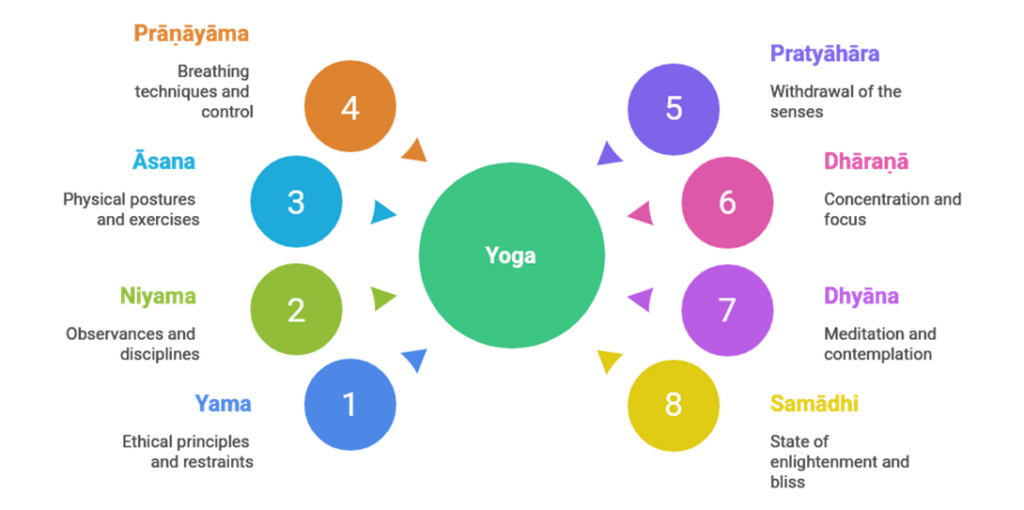
Figure 1: Eight Limbs of Yoga
Sathya Sai Baba also emphasized the importance of Yama and Niyama in his discourse “5 Yamas in the Path of Yama and Niyama” (October 5, 1989). He stated that these five Yamas are the marks of true humanity. If a person does not possess these five important values, he does not have true humanity. By practicing Yama, one conquers even Yama, the god of death.
An unsteady and frustrated mind may arise due to the triple fault of mala (impurity/negative) vikshepa (fickleness/restlessness), and Avarana (veil of ignorance/body-consciousness/false identification with appertaining characteristics.) Only by eliminating these three faults from the mind can we expect to develop control over ourselves and reach self-realization and ultimate peace.
Mala includes all impurities, negative traits (commonly referred to as the Arishadvarga), and/or vikshepa (the constant activity of the mind creating difficulty in developing focused concentration on one object). The third cause of an unsteady/frustrated mental state, Avarana, is defined as the veil of ignorance. before the act of seeing our true selves.
The removal of any of the above three causes will help one know the truth and lead one towards a tranquil life. The removal of the above three causes from the mind is essential; otherwise, it is not possible to attain a tranquil/controlled state of mind by Ashtanga Yoga.
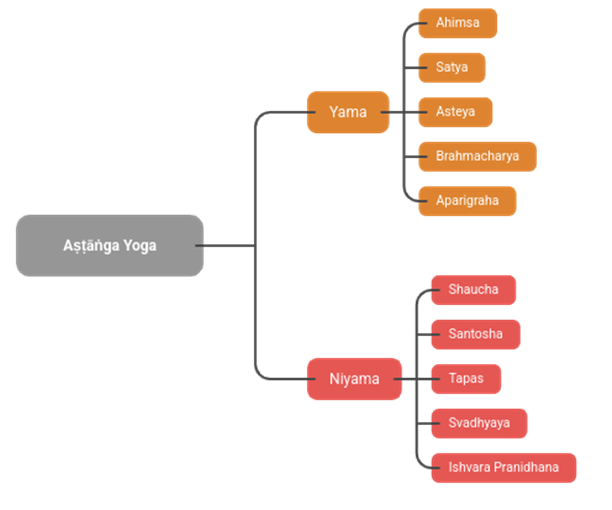
7.1 Yama: Under Yama are Ahimsa, Satya, Asteya, Brahmacharya, and Aparigraha. Under Niyama are Shaucha, Santosha, Tapas, Svadhyaya, and Ishvara Pranidhana. Yama represents external ethics, and Niyama represents internal discipline.
Figure 2: Yama and Niyama In Astanga Yoga.
Ahimsa means non-violence—not harming anyone through thought, speech, or action. Satya means truthfulness— “सत्यं वद.” [6] Asteya means non-stealing. Brahmacharya is the constant connection with Brahman and the control over one’s senses. In the book on the Practice of Brahmacharya, Swami Sivananda writes that “life is Chaste; death is Sensual.”[v] [7]Patanjali states that “when one is engaged in practicing Brahmacharya they have obtained great energy.”[8] Aparigraha is the principle of simplicity and non-attachment. In one of the famous verses of Bhaja Govindam, written by Adi Shankaracharya, it has been clearly mentioned that we have desires for pleasure until we attain old age. Therefore, it is essential that we can moderate and content ourselves to attain peace of mind. [9]
7.2 Niyama, the internal discipline. The initial one is Saucha which means cleanliness, purity and clarity. Neither is physical cleanliness just limited to Saucha, quite the reverse, it refers to internal purity more importantly. The mind has to be clean and neat without any bad and unnecessary thoughts. Throwing away unwanted thoughts and having a few, clean and clear thoughts is the greatest secret of turning to the spiritual path in a clean and pure way. We are told that cleanliness is next to goodliness. If our environment is clean and well kept, our mind will be in a peaceful condition. A room, in which things are scattered hither and thither in a disorderly manner, will not make us be in a peaceful state. Whenever we need something, we will search in frustration. As it is famously said, “There is a place for everything, and everything in its place.” [10]External cleanliness supports internal cleanliness and a calm mind. By keeping things properly and maintaining purity through positive thoughts and remembrance of good things, our words, speech, and actions gain clarity. This helps us control the mind and maintain peace.
The second is Santosha, contentment. Being satisfied with whatever we have is a great virtue. Whenever we see something, we develop a desire to have it. Even after achieving what we desired, we look for something higher and again develop new desires. Mahatma Gandhi says, “The earth provides enough to satisfy every man’s need, but not every man’s greed.” Being content and moderate is very important in the spiritual journey. It is often written in public places, “Less luggage, more comfort.” In the same way, fewer desires bring greater comfort in spiritual life and help us control the mind and live peacefully.
The next is Tapas, which means discipline and sacrifice. In the Bhagavad Gita, it is mentioned that Tapas can be of three kinds: physical, related to the body; verbal, related to speech; and mental, related to the mind.
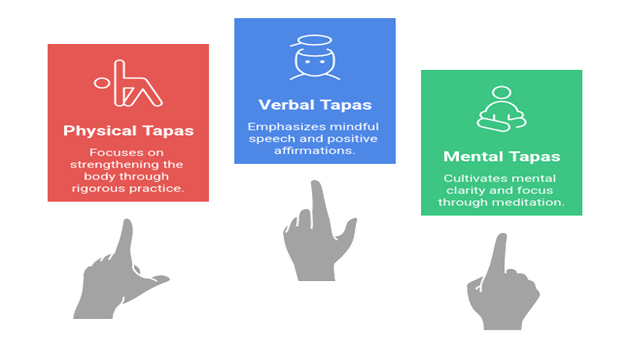
Figure 3: Three Types of Tapas[11]
Physical Tapas comprises worshiping God, purity, simplicity, non-violence, and control of actions. Physical discipline can be practiced for concentrating the mind, conquering laziness, and overcoming the quality of Tamoguna. Keeping the body engaged in physical activities and performing good deeds such as service to others can purify the mind. As it is said, “चित्तस्य शुद्धये कर्म” — action purifies the mind. [12] Also in Gita (5.11): “Yogis perform action for the purification of the mind (ātma-śuddhi).”[13] By doing selfless actions, we can eliminate Mala, one of the three impurities, and purify the mind.
The second type is Vak Tapas or austerities of speech. This consists of speaking the truth, speaking pleasantly, not hurting others by speech, study of scriptures, and speaking words that are beneficial to others. In Subhashitani it is said: “सत्यं ब्रूयात् प्रियं ब्रूयान्न ब्रूयात् सत्यमप्रियम्” ।[14]
We should utter truth in a pleasant way. We should neither utter truth in a harsh way nor pleasant things that are untrue. This is an ancient practice that helps us discipline our speech and purify our minds. So, we should utter truth in a noble and pleasant way.
Manasika Tapas, the third type, is a mental austerity that entails calmness, gentleness, silence of the mind, self-control, purity of intention, and absence of hidden motives. Practicing silence of the mind, positive thoughts, and wishing well for all, and having pure intentions, help us attain a calm and peaceful state of mind. The above three Tapas, related to body, speech, and mind, help us purify ourselves completely.
Next up is Svadhyaya, which is self, study. When we learn about the mind from scriptures, philosophy, ethics, and stories, it gives us more insight into our nature and mind control.
For a simple man, self, study would be self, awareness one’s strengths, weaknesses, and areas of temptation. Identification of our distractions and consulting spiritual teachings inspire us to make the effort and dedicate ourselves to mind control. It said:
“प्रयोजनमनुद्दिश्य न मन्दोऽपि प्रवर्तते ।”[15] Without specifying a purpose or benefit, even a dull person will not act. Therefore, through Svadhyaya, we understand the purpose and benefits of mind control and become motivated to practice it. Also, in It appears in the Taittiriya Aranyaka 2.15 “One must study one’s own scriptural text/self” or “Vedic study is to be undertaken.”
The last one under Niyama is Ishvara Pranidhana, which is the surrender to God. This includes the surrender of oneself at the lotus feet of God, the surrender to the Guru, and the knowledge that all this happens by the will of God. By realizing that all this exists because of God and that we are what we are because of His grace, we become humble and noble. By surrendering to the Guru and God, we can control the mind.
We may miss some practices, we may lack capacity in certain disciplines, and we may fail in some efforts. But without surrender at the Guru’s feet and at the divine lotus feet of God, all practices become incomplete. It is like performing rituals without devotion. True surrender and sincere prayer help us cross the bondage of samsara, the cycle of birth and death.
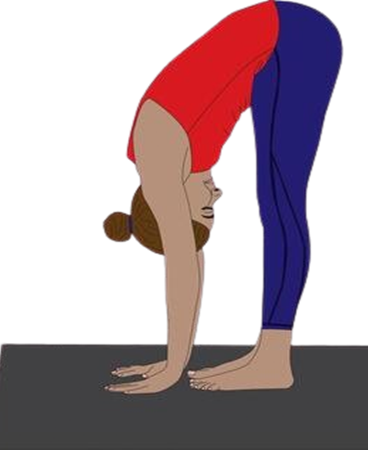
7.3 . Asana – Stability of Body and Mind
B.K.S. Iyengar, the author, explains in detail the effects of Uttanasana and how it can bring about these changes. [vi]
The pose helps in conditions of the stomach pain and menstrual discomfort. Also, the heartbeat returns to a slower rhythm. The nerve cells along the spine are reactivated. The feelings of depression are alleviated. If one holds the posture for two or more minutes, especially for people who get excited quickly, it calms the brain cells. After finishing the asana, one feels calm and cool. The eyes begin to glow, and the mind feels peaceful. The benefits of the asana are clearly mentioned in this book and show how effectively it works on both body and mind.[16]
Many different asanas are named in the classics of yoga, for example, Padmasana and Vajrasana. Still, the primary objective is the capability of sitting steadily for a lengthy duration. Any posture can be used if it is stable and comfortable. Such steadiness helps us observe the mind and breathing, overcome the senses, and gradually gain control over the body and mind.[vii]
When we are physically unsteady, we cannot control our mind. Stability of posture leads to stability of thought.
Example from Buddha – Muddy Water: As mentioned in the Udaka Sutta (Anguttara Nikaya), there is an example where muddy water becomes clear when left undisturbed. Once, a disciple went to fetch water from a pond, but a vehicle had just passed through, disturbing the water and making it muddy. The disciple returned and informed the Buddha that the water was dirty. The Buddha asked him to go again after some time. When the disciple returned later, the mud had settled, and the water had become clear.
In the same way, when the mind is disturbed, clarity is lost. When it is left undisturbed and made steady, impurities settle down, and clarity arises naturally.[17]
Another example that can be given is the reflection of an image in water.[18]
7.4. Pranayama – Control of Breath
Pranayama, which literally refers to the expansion and regulation of life force, goes through the processes of breath control, breath restraint, and conscious breathing. For example, when our emotions like anxiety, frustration, or worry take a hold of us, we tend to breathe rapidly and erratically. This is only one factor among others triggering higher blood pressure and a restless mind.
It is an established fact that breathing patterns have a significant impact on mental states. During pranayama exercises, the breathing rate decreases leading to the lowering of blood pressure while the mind gets into a state of calmness. In fact, breath regulation is the secret for mind regulation.[viii]
In the first place, the breath should be observed in a simple manner. We should not try to do anything to the breathing but simply observe the breathing in and out. This natural observation of breathing will bring ease to the breath as well as to the mind. Gradually, the mind becomes calm and peaceful.
Scientific studies have proved that balanced breathing can activate the parasympathetic nervous system, reduce stress, lower anxiety, and enhance concentration. Balancing inhalation and exhalation can reduce many mental disturbances and bring mastery over the mind. Therefore, whenever something goes wrong, instead of worrying, we should take deep breaths. Observing and regulating the breath is one of the simplest and most powerful methods to control the mind.
7.5. Pratyahara – Withdrawal of the Senses
Until now, we have dealt mainly with external disciplines. Now we are entering the internal world. Pratyahara is the fifth limb of yoga. At this stage, we begin observing the “monkey mind” and its constant movements. Every day, thousands of thoughts arise in the mind. It is said that around 6000 new thoughts pass through the mind daily. Many of these thoughts are unnecessary and disturbing.
In Pratyahara, the idea is to observe the mind without the habit of reacting. So, we don’t force the thoughts to go away but just let them be. At the same time, we intentionally get rid of the thoughts that make us unstable, low, angry or fearful. Like weeds that need to be uprooted otherwise they grow again, so negative thoughts, too, need to be uprooted.
Throughout life, numerous unnecessary impressions get stored in the mind. With Pratyahara practice, we start to remove these accumulated distractions. Having a purified mind, one gets clarity. This leads us to the next stage, Dharana (concentration). Pratyahara is closely linked with Dharana, the sixth limb of yoga. Swami Sivananda said: “Pratyahara itself is termed as yoga, as it is the most important limb in yoga Sadhana.”[19]
7.6 Dharana – Concentration: The subsequent limb is known as Dharana. “Dharana” is derived from the root “dha, ” which means “to hold” or “to maintain.” Therefore, Dharana is the act of holding one’s mind steadily on a single point of focus.
In fact, Pratyahara (withdrawal of the senses) and Dharana are so closely related that a person who intends to practice them can hardly recognize the difference between them. Primarily, it regulates the senses and draws the mind to focus provokingly. Practicing pratyahara is like stopping the senses from outward distractions so that one can have full control of the mind or consciousness. Similarly, in the process of practice, after one brings his mind and consciousness to rest, the next step is to, dharana i.e. keeping the mind obligate. With a single, pointed mind, it is possible to channel one’s energy toward the proper objective. In the Yoga Sutras “Dharana is the binding of the mind (chitta) to one place (desa).”[20]
According to Yoga philosophy, the mind moves due to:
- Vasanas (past impressions)
- Raga–Dvesha (likes and dislikes)
- Attraction toward sense objects (Indriya attraction)
Dharana weakens these disturbances by:
- Training attention
- Reducing the momentum of thought
- Increasing willpower (sankalpa-shakti)
- Earlier, Patanjali defined Yoga (1.2): योगश्चित्तवृत्तिनिरोधः means “Yoga is the cessation of the modifications of the mind.” The practical application to attain this calmness is Dharana.[ix]
Dharana in the Bhagavad Gita: The process of concentration has been described in detail by Lord Krishna in the Bhagavad Gita too. The seeker has to find a clean and quiet place, sit steadily in a comfortable posture with the spine, neck, and head erect, and then concentrate with his mind.
By way of Yama, Niyama, Asana, Pranayama, and Pratyahara, the cleansing of mind has already taken place. With Dharana, it is our task to grasp and hold one good and bright thought strongly to a point of fixation. The mind gets more regulated and concentrated by getting hold on to the thoughts that bring one the sense of energy, clarity, and calmness. Concentration flowing free without a stop or break is true concentration or Dhyana.
7.7 Dhyana – Meditation
Dhyana means contemplation or it means meditation or continued flow of thought or contemplation upon one object without any distraction. It is easier in the beginning to practice Saguna Dhyana or meditation upon form. One may meditate upon any form or idol or deity. Nirguna Dhyana or meditation upon formless Absolute may be difficult in the beginning. It means meditation upon the Self or upon the formless Absolute. After attaining success in the preceding stages or degrees of meditation or contemplation, one may attain success in this higher degree of meditation or contemplation. It brings one great knowledge or understanding or purity.
Dhyana Mudra “Dhyana” means a state of deep meditation or profound contemplation whereas “Mudra” refers to a gesture or a seal. We use the Dhyana mudra to help with meditation as it can lead to better concentration, mental sharpness, and a deeper level of meditation. It assists in the calming of stress and worry, brings balance to one’s emotions, and even results in the enlightenment of one’s inner self. Furthermore, it is a great remedy for insomnia. When a person does Dhyana Mudra while they meditate, steadiness of the body will result in steadiness of the mind. Hence, you will gain better control over your body as well as your mind, leading to the mastery of one’s own mind.[x]
7.9 Samadhi – The Ultimate Peace
The final limb is Samadhi. This is the goal toward which all previous practices lead.
युञ्जन्नेवं सदात्मानं योगी नियतमानस: |
शान्तिं निर्वाणपरमां मत्संस्थामधिगच्छति || 15|| [21]
“Thus, always keeping the mind controlled and practicing meditation, the yogi attains supreme peace — the highest liberation — abiding in Me.”
Control of the mind is the key to attaining eternal peace, which is liberation (moksha).
Samadhi is a state where there is equality in vision and perfect equilibrium. The mind is perfectly steady and calm and is established in the Self. Alternate Paths to Peace. Even if one is unable to practice all eight limbs step by step, the Bhagavad Gita provides other ways.
Bhagavad Gita, Chapter 2, Verse 71:
विहाय कामान्यः सर्वान्पुमांश्चरति निःस्पृहः ।
निर्ममो निरहङ्कारः स शान्तिमधिगच्छति ॥
“One who gives up all his desires, who lives free from craving, possessiveness, and egoism, attains peace.”
Peace is achieved when all the desires merge in God. If a person is free from all the unnecessary cravings of life, he will be peaceful from within.
The Gita has given a beautiful example that just as the rivers enter the ocean without disturbing it, the wise man remains calm when experiences enter life. If a person remains positive towards everything in life, he will attain Shanti. Further, in Gita
अन्ये त्वेवमजानन्तः श्रुत्वान्येभ्य उपासते ।
तेऽपि चातितरन्त्येव मृत्युं श्रुतिपरायणा:॥
Some people reach realization by means of meditation. Some others get this fulfillment through knowledge. And there are also those who achieve it by means of selfless action (karma yoga). Even those, who with faith simply listen to the preaching of saints, very slowly, step by step, cross the ocean of birth and death. So, whatever be the case, meditation, knowledge, action or devotion, through them, peace can be obtained.
Conclusion
Controlling one’s mind is the only way to stable and lasting peace. Focusing, meditating, and being engrossed in a state of meditation are the means through which the practitioner moves from one point to another and eventually, freeing oneself. The highest peace arises spontaneously when the desires are given up, the ego is annihilated, and the mind is firm.
There is a well-known phrase that gets credited to Abraham Lincoln “If I were given 6 hours to cut down a tree, I would take 4 hours to sharpen the axe.” The point of this phrase is: the essential part of preparation precedes the action. So, before cutting the tree, one must sharpen the axe. Also, before solving the problems of life, we first need to sharpen and train our mind.
Right pruning, training, and mastering of the mind are the pillars upon which we can stand even during the hardest times and finally reach Manas Shanti the perfect peace.
References
[1] Vivekachudamani, Verse 76 Author: Adi Shankaracharya
[2] Bhagavad Gita 6.6
[3] Bhagavad Gita: Chapter 3, Verse 12
[4] Patanjali. Yoga Sutras, 1.2 (Samādhi Pāda).
[5] Patanjali. Yoga Sutras, 2.29 (Sādhana Pāda).
[6] Taittiriya Upanishad 1.11.1
[7] ಬ್ರಹ್ಮಚರ್ಯವೇ ಜೀವನ, ವೀರ್ಯನಾಶವೇ ಮೃತ್ಯು By ವಿ. ಶಿವಾನಂದಸ್ವಾಮಿ, Publication date, 1950, Topics: RMSC , Publisher: ಬಾಲಚಂದ್ರ ವೆಂಕಟೇಶ ಘಾಣೇಕರ, Collection digitallibraryindia; JaiGyan Language Kannada
[8] Yoga Sutras of Patanjali 2.38 “ब्रह्मचर्यप्रतिष्ठायां वीर्यलाभः”
[9] Bhaja Govindam, Verse 29, Author: Adi Shankaracharya
[10] Franklin, Benjamin. The Life of Benjamin Franklin (Autobiography), 1791.
[11] Bhagavad Gita, Chapter 17, Verse 14, 15, 16, 17, 18, 19.
[12] Vivekachudamani – Verse 11, Written by Adi Shankaracharya.
[13] Bhagavad Gita – Chapter 5, Verse 11
[14] Manusmriti (Chapter 4, Verse 138) & Subhashitani
[15] Nyāya maxim (न्यायसूक्ति): “प्रयोजनमनुद्दिश्य न मन्दोऽपि प्रवर्तते।”
[16] Iyengar, B. K. S. The Illustrated Light on Yoga. London: HarperCollins Publishers, 2005.
[17] Udaka Sutta – Anguttara Nikaya, Old Path White Clouds – Thich Nhat Hanh.
[18] Dhammapada
[19] Sivananda, Swami. Sadhana: A Textbook of the Psychology and Practice of the Techniques of Yoga. Divine Life Society, Rishikesh. Chapter: “Yoga Sadhana: Its Eight Fundamentals.”
[20] Patanjali. Yoga Sutras, 3.1, Vibhūti Pāda. देशबन्धश्चित्तस्य धारणा ॥ ३.१ ॥
[21] Bhagavad Gita, Chapter 6, Verse 15:
[i] https://www.holy-bhagavad-gita.org/chapter/6/verse/6/ Bhagavad Gita: Chapter 6, Verse 6
bandhur ātmātmanas tasya yenātmaivātmanā jitaḥ anātmanas tu śhatrutve vartetātmaiva śhatru-vat.
[ii] The Four Parts of Mind – Harnessing the True Power of the Mind https://isha.sadhguru.org/yoga/yoga-articles-mind-stress/parts-of-mind/
[iii] What is Mind According to Yoga? https://www.fitsri.com/articles/four-parts-of-mind-in- Bhagavad Gita: Chapter 6, Verse 17 yoga#:~:text=What%20makes%20the%20mind%20%E2%80%9CMIND,%2C%20an%20undistracted%2C%20still%20core!
[iv] The Dhammapada. Translated by Gil Fronsdal, Shambhala Publications, 2005.
[v] ಬ್ರಹ್ಮಚರ್ಯವೇ ಜೀವನ, ವೀರ್ಯನಾಶವೇ ಮೃತ್ಯು By ವಿ. ಶಿವಾನಂದಸ್ವಾಮಿ, Publication date, 1950, Topics: RMSC , Publisher: ಬಾಲಚಂದ್ರ ವೆಂಕಟೇಶ ಘಾಣೇಕರ, Collection digitallibraryindia; JaiGyan Language Kannada
[vi] On page 52 of “The Illustrated Light on Yoga” by
[vii] Iyengar, B. K. S. The Illustrated Light on Yoga. New York: Rodale Inc., 2005.
[viii] Breath Control Reduces Stress & Anxiety, Scientific Reports — Effect of breathwork on stress & mental health https://www.nature.com/articles/s41598-022-27247-ynature.com
[ix] Jadeja, A. H. (2025). Practices of Dharna and Its Benefits in Various Scriptures. International Journal of Creative Research Thoughts (IJCRT), 13(10).
[x] Understanding Dhyana mudra: Benefits and practice: https://www.idanim.com/blog/dhyana-mudra-meditation-and-its-benefits