
The Sacred Blueprint: Evolution, Style, and Symbolism in Hindu Temple Architecture
Madhu M C
Master’s in Vedic studies.
Department of Sanskrit and Vedic Studies
Sri Sathya Sai University for Human excellence
Navanihala, Kalaburgi, Karnataka
Abstract
The Sacred Blueprint: Evolution, Style, and Symbolism in Hindu Temple Architecture explores the deep connection between ancient Indian construction and spiritual philosophy. This paper examines how Hindu temples are more than just buildings, serving as physical representations of the universe and the human body. By studying the Vastu Purusha Mandala, the research explains the mathematical and geometric foundations that guide every temple’s design. The study tracks the historical journey of these structures, from simple rock-cut shrines to the massive, freestanding masterpieces seen today.
A central focus of the paper is the comparative analysis of the Nagara style of the North and the Dravida style of the South, highlighting their unique towers and gateways. It also investigates the Vesara style, which emerged as a creative bridge between these two dominant traditions. Beyond their physical forms, the article discusses the symbolic role of the temple as a “chariot” or “palace” for the divine. Furthermore, it highlights the temple’s historical importance as a vital centre for social, economic, and educational life in Indian society. Ultimately, this study provides a fresh perspective on how ancient stone edifices reflect the timeless cosmic worldview of India.
Key Words:
- Nagara, Dravida, Garbha Griha, Shikhara, Dvarapalas, Naivedyam, Bhajans and Keerthana’s, Hindustani and Carnatic music, Kutiyattam, and Bharatanatyam.
Introduction
Architecture in a country is always changing as the years go by because styles and trends move in new directions. India’s building styles have gone through many big changes over a long time. Because Indian civilization is one of the oldest on Earth, it’s very first buildings have a unique look that you won’t find anywhere else. As time went on, Indian architecture started to show influences from other cultures that came into the country. Just like in other parts of the world, the way buildings were designed in India tells the story of how Indian society itself was changing and growing. By looking at these structures, we can see the history of the people who lived there.
Building an Indian temple wasn’t just about stacking stones, it was a way to turn spiritual beliefs into something you could touch and see. The temple was designed to be like a grand palace or a moving chariot for a god, serving as a bridge that connects our everyday world to the divine world. The history of how these temples were built can be broken down into three main steps. It started very simply with rooms carved directly into solid rock caves. Over many years, these designs grew more complex until they became the massive, highly decorated stone buildings we see today.
A Hindu temple is a sacred place where people go to worship and feel the presence of God. These temples are seen as the homes of deities, acting as a bridge between the human world and the divine. While Hindus are not strictly required to go to a temple at a specific time or in a large group, the temple is still a very important place for the community to gather. People visit to see the sacred image of the main deity, called a murti, and to receive blessings through a process called darshan. During their visit, devotees may sing songs, say prayers, or leave offerings like food or flowers. Historically, temples have also been used for local events, art, and music. These buildings are famous for their amazing designs, beautiful carvings, and very tall towers.
The Origins of the Hindu Temples.
The evolution of the Hindu temple represents a profound shift from the temporary sacrificial altars of the Vedic period to the permanent stone monuments that mirror the cosmos. While early religious spaces in the Indian subcontinent such as the Buddhist stupas and Jain monuments survive from the centuries BCE, early Hindu structures likely perished due to their construction in wood and other perishable materials. The true transition began in the 5th century CE in Northern India and the 6th century CE in Southern India, coinciding with the rise of Puranic devotionalism and the Bhakti movement. During this formative Gupta period, builders moved away from wood to freestanding stone and brick, initially borrowing design elements from Buddhist architecture, such as the circular ambulatory paths used for circumambulation. These early shrines, like those at Sanchi, typically chambers cellas, which gradually evolved into the iconic soaring spires known as Shikharas.
Ancient Indian temple design is generally classified into three primary architectural categories: the Northern Nagara style, the Southern Dravida style, and the Vesara style, which blends elements of both. Beyond these major traditions, unique regional variations also emerged in areas like Kerala, Bengal, and the Himalayan regions. A defining characteristic across all these styles is the intricate ornamentation, which is visible in both the complex architectural structures and the detailed figurative sculptures that adorn them.
At the heart of every temple is the Garbha Griha, a sacred space that houses the primary deity and is typically surrounded by a path for ritual circumambulation. While the core purpose remains the same, the layout varies, for example, Southern complexes frequently feature multiple smaller secondary shrines. Early on, the distinction between Northern and Southern styles was most visible in their vertical shapes and entrances. In the North, the shikhara or the tower is the most dominant visual element, while the entrance remains relatively simple. Conversely, Southern temples are famous for their massive gopurams and extensive enclosure walls that guide worshippers into the central courtyard. Despite these stylistic differences, both traditions share a common underlying logic and many structural similarities.
The design of a Hindu temple is based on a balanced and symmetrical plan. It uses a mathematical grid made of squares to create perfect geometric shapes like circles and squares. At the very centre of the building is a small, quiet room called the garbhagriha, or “womb-chamber.” This is the most sacred part of the temple where the main statue of the deity is kept. It represents the connection between the physical world and the universal spirit. Directly above this room, a tall tower rises toward the sky, which is called a Shikhara or a Vimana. The architecture also includes special areas for people to use during their visit. There is a walking path around the inner room for parikrama, where followers walk in a circle to show respect. Most temples also have a large hall where people can gather, as well as a porch at the entrance. More than just a building, the temple is a work of art that reflects the values and the way of life in Hinduism. It acts as a bridge that brings people closer to the divine and the universe in a holy space.
The Religious Studies of Temples.
The concept of a Hindu temple might seem confusing to those who believe that the presence of the divine is everywhere, but in the Indian philosophy, God is viewed as existing within the individual, across the entire universe, and with special intensity in specific sacred spots. These are the locations, where the divine presence is felt most strongly, are where temples were constructed. Different traditions like Vaishnavism, Shaivism, and Shaktism have their own maps of these holy sites, often choosing places where major mythological events occurred. Moust of these shrines are found near mountains, caves, or rivers. A river crossing, known as a tirtha, serve as a spiritual bridge where the earthly and heavenly worlds meet. Similarly, the temple Shikara, is designed to look like mountain peak to represent the home of the god and goddesses. By building in these locations, the temple acts as an important point that helps people connect with the divine power.
Temples are frequently established at sites, where the immortalized by the Sanskrit epics, such as the Ramayana and Mahabharata, or within the vast narratives of the Puranas. Whenever a scripture describes a holy miracle or a divine manifestation, a physical shrine is usually erected to mark that spot. Many of these locations possess unique local legends known as Sthalapuranas, which explain the specific history and spiritual importance of that place or the ground. While many temples are designed to shelter Murtis carefully carved by skilled artisans, others are built to protect Swayambhu images, which are believed to have appeared naturally on their own rather than being made by human hands. These self-manifested objects are considered so sacred that the entire temple structure is organized specifically to surround and honour them.
A Hindu temple is far more than a simple portal to the divine, it is viewed as the actual residence of the god or goddess. Inside this sacred home, the murti is cared for like a living guest, following a daily schedule that includes waking up, taking meals, meeting with followers or devotees, and sleeping. This idea of a domestic dwelling is reflected in the traditional names for temples, such as devagriham, devalaya, devasthanam, and mandiram, all of which translate to words like “house,” “place,” or “living quarters” of the deity. By treating the space as a home, the community transforms the temple into a site of intimate, personal interaction with the sacred.
The Spirit and Design of Hindu Temples.
Hindu temples are far more than just impressive buildings; they are designed to reflect the deep belief that everything in the universe is connected. The architecture serves as a physical map of the four main goals of human life: seeking prosperity or Artha, enjoying life’s pleasures or Kama, living virtuously or Dharma, and reaching spiritual liberation or Moksha. Through detailed carvings and precise mathematical layouts, these structures act as a bridge between the physical world and the divine. At the heart of every temple lies a quiet, empty space located near the main deity. This plain area represents Purusha, the universal spirit or consciousness that has no form but exists everywhere. The temple environment is meant to clear the mind and help visitors on their personal journey toward self-discovery, though the way a person chooses to worship is always a personal choice.
Visually, these temples are famous for their tall, striking towers. While Northern and Southern Indian styles are the most common, you can find many unique regional designs throughout India. Today, as Hindu communities grow around the world, temple styles have become even more diverse. Some are grand, traditional monuments built by master craftsmen, while others are simple, modern spaces or repurposed buildings that focus more on community prayer than ancient architectural rules. Beyond the most common designs, several regions have developed their own signature looks based on local materials and history. For example, temples in Kerala and Nepal are famous for their stepped roofs and heavy use of timber; while they look like East Asian temple tower, this is likely because both regions relied on wood as a primary building material. In Bengal, architects created a distinct look using curved, sloping roofs and decorative terracotta. Meanwhile, the Hoysala Empire in Karnataka produced a completely unique style, easily identified by its complex star-shaped foundations and incredibly fine stone details.
In our Indian Temples once you step inside the temple halls, you will see that almost every pillar, wall, and ceiling is covered in art. There are detailed carvings and paintings that tell stories of gods and ancient legends. Some are very colourful and bright, while others are simple and calm. Right at the front of the temple, we will see a very tall pillar called the Dhvajastambha. It looks like a giant flagpole and is often covered in shiny bronze. This pillar has been part of temples for a very long time. It is there to show everyone that the temple is the “home” of the deity, acting like a royal flag that welcomes visitors.
Choosing the Perfect Spot for a Temple.
Hindu temples are usually built in large, open areas surrounded by nature. According to ancient Indian texts, the ideal location for a Mandir is near water and lush gardens. The Puranas and The Bharata Samhita books suggest that gods prefer peaceful places where flowers bloom, birds sing, and animals can rest safely. Because of this, many famous temples are found near riverbanks, lakes, or the ocean. However, the ancient guides also say that if a natural water source isn’t available, a temple can still be built there. In those cases, it is recommended to dig a pond or build a water garden nearby. Even if there is no water at all, it is still used symbolically during the temple’s special opening ceremonies to maintain that connection to nature.
Beside many temples, we will find a large water tank or known as Kalyani. These tanks are built so that worshippers can wash and purify themselves before entering the sacred space. This tradition reflects the ancient belief that temples should be located near holy water. Beyond their religious use, these tanks often serve a practical purpose by storing water for local farming. In some cases, you might even see a small shrine built right in the middle of the water.
Indian temple architecture is divided into two main styles: the Nagara style, which is characteristic of Northern India, and the Dravida style, which is found throughout Southern India. While both share the same basic religious purpose, they are easily distinguished by the shape of their towers and their overall layout.
- Architecture of North Indian Temples.
The Nagara style, which became popular in Northern India between the 7th and 14th centuries, is defined by its focus on vertical lines and mountain-like shapes. These temples are typically built on high stone platforms with stairs leading up to them. Unlike Southern temples, Nagara designs usually do not have large boundary walls or massive gateways.
Key Architectural Features:
- The Shikhara: The most famous feature is the towering spire known as the Shikara, which means “mountain peak.” This tower curves gently inward as it rises, following a precise mathematical pattern of squares and circles. While early temples had just one tower, later designs often featured multiple smaller peaks.
- The Garbhagriha: Directly beneath the tallest tower lies the Garbhagriha. This is a square, sacred room that houses the main deity. In Northern temples, these central statues, are frequently carved from white marble.
- The Layout: From above, the temple starts as a square, but the walls have stepped projections that make it look like a cross with many angles. These vertical lines continue all the way up the tower, making the building look even taller and more majestic.
- The Mandapas: To reach the inner sanctuary, worshippers walk through one or more mandapas, which are pillared halls or pavilions. These serve as a transition from the outside world to the quiet, holy centre.
The Kandariya Mahadeva Temple of Khajuraho is a perfect example for Nagara style. While the Nagara style follows these general rules, it changed slightly in different regions, allowing for unique local varieties across Northern India.
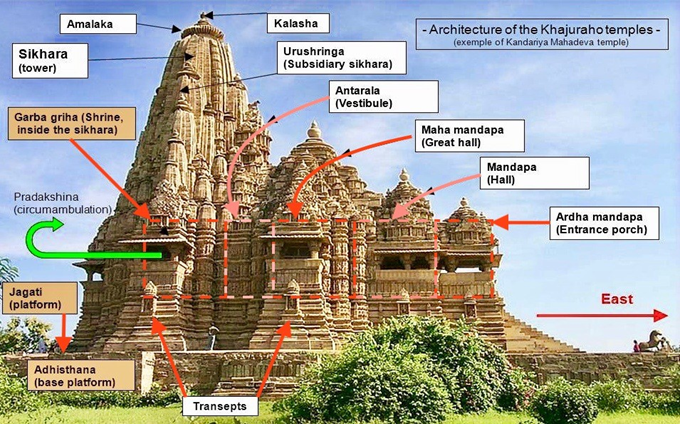
The Kandariya Mahadeva Temple at Khajuraho.
- Architecture of South Indian Temples.
The Dravida style of Southern India is famous for its grand scale and geometric precision. Unlike Northern temples, these are usually enclosed within high boundary walls and feature large water tanks for rituals.
Key Architectural Features:
- The Vimana: The tower over the main sanctuary is called the Vimana. It is shaped like a stepped pyramid that rises in clear layers, rather than the curved shape seen in the North. The very top “cap” of this tower is what Southerners call the Shikara.
- The Gopurams: These are the massive, decorative gate towers at the temple entrances. Over time, these gateways became so tall that they often stand much higher than the main temple tower itself.
- The Dvarapalas: Instead of river goddesses, the entrances of Dravida temples are guarded by fierce Dvarapalas carved into the stone.
- The Murtis: While Northern temples often use marble, the sacred statues in the South are typically carved from dark granite.
- The Layout: The central sanctuary is always a square room housed within the Vimana. Worshippers enter through the towering Gopurams into a self-contained complex that feels like a sacred city.
The Brihadisvara Temple in Thanjavur is a perfect example for Dravida style. Which is known for its massive pyramidal tower and detailed stone carvings.
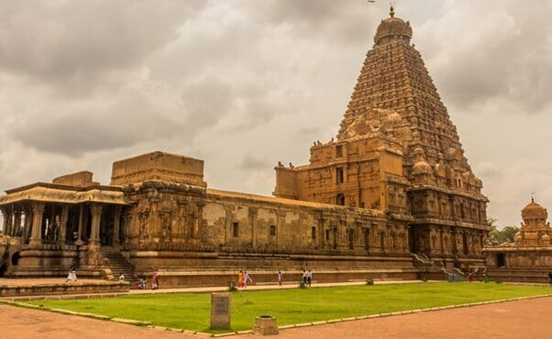
The Brihadisvara Temple in Thanjavur.
The Art of Devotion and Sacred Respect.
Visiting a Hindu temple is a journey of both physical and spiritual purification. Before entering, visitors remove their shoes and slippers to keep the “home of the deity” clean and follow modest dress codes, such as the traditional shirtless requirement for men in certain Southern regions. The experience often begins by honouring Ganesha, the remover of obstacles, through prayers or the ritual breaking of a coconut. As devotees move through the complex, they practice Pradakshina, which involves walking clockwise around the shrines to keep the sacred space on their right side. This leads to the central moment of the visit, Darshan, where the worshipper stands before the deity in the inner sanctuary. Here, they offer flowers or fruit, perform the Anjali mudra or joined palms, and may quietly chant Vedic Matras or sing bhajans to express their devotion.
The atmosphere of the temple is maintained by priests who bridge the gap between the divine and the devotee. They care for the deity as a royal resident, performing ceremonies like ritual bathing known as Abhisheka and offering of light known as Arti. After these rituals, the priest distributes the deity’s blessings to the people in the form of Prasada, sanctified food or flowers and may offer holy water or sacred powders like Vibhuti and kunkuma for the forehead. By touching the arti flame and bringing its warmth to their eyes, worshippers symbolically receive the light and grace of the deity. This structured interaction, combining personal prayer with ancient priestly rituals, is designed to clear the mind and help every visitor on their unique path toward self-realization.
The daily life of a temple follows a rhythmic cycle designed to treat the deity as a living, royal guest. While every temple adheres to its own unique schedule, most begin before dawn with the Suprabhatam, a series of gentle hymns intended to wake the deity. Following this awakening, the priests perform a sequence of services, which include bathing the icons, adorning them in exquisite silks and jewellery, and offering Naivedyam, specially prepared sanctified food. Once these private morning preparations are complete, the doors are opened, allowing the public to enter for Darshan, the sacred moment of eye contact between the worshiper and the divine. As the day progresses, the temple typically observes a period of quiet in the midafternoon, closing its doors so that both the deity and the officiating priests can rest. This mirrors the natural human cycle of mid-day repose. In the late afternoon, the temple hums back to life with evening prayers and rituals that continue until the final service of the night, when the deity is symbolically put to sleep. On special occasions, this routine expands into the streets through a Ratha Yatra, where the icons are placed upon massive, decorated chariots and pulled by devotees in a grand procession. This allows the deity to bless the entire community, transforming the surrounding area into an extension of the sacred sanctuary.
The Temple as a Community and Cultural Hub
While a temple is primarily a place for prayer, it also serves as a vibrant centre for social, economic, and cultural life. Historically, temples were major landowners and drivers of local agriculture. Today, they remain economic powerhouses that require significant funding for maintenance, ritual supplies, and to support the priests who dedicate their lives to temple service. These funds come from generous donors, payments for specific private rituals, and the Hundi (collection boxes) found throughout the premises. Devotees also contribute through gifts, such as fresh produce or beautiful silk saris used to dress the deities. Many temples use this collective wealth to run charitable programs, such as schools, hospitals, and free meal centres.
The experience of a temple is incomplete without the presence of food and the arts.
- Sacred Food: Most temples provide Prasada, a blessed treat like a sweet laddu to every visitor. Larger temples even run massive canteens that serve full meals to thousands of devotees daily.
- The Soundscape: A temple is a feast for the senses. Along with the scent of incense, the air is filled with the sound of blowing conch shells, rhythmic drumming, and devotional singing like Bhajans and Keerthana’s.
- Performance Space: For centuries, temples have been the stage for India’s greatest artistic traditions. From the classical Hindustani and Carnatic music to ancient Sanskrit dramas like Kutiyattam in Kerala, the arts are seen as a form of worship. Even classical dances like Bharatanatyam, which originated in the temple halls of the South, continue to be performed in cultural wings attached to modern temples.
For Indian communities living abroad, the temple takes on an even deeper meaning. It acts as a vital bridge to their heritage and a place to maintain their cultural identity. Beyond the shrine room, you will often find community halls used for weddings and festivals. Many temples also host “Sunday schools” where the younger generation can learn their mother tongues and study ancient Indian history and philosophy. In this way, the temple is not just a building of stone; it is the heartbeat of the community, keeping ancient traditions alive in a modern world.
Conclusion.
The Hindu temple stands as a timeless synthesis of art, science, and spirituality, representing the very heartbeat of Indian civilization. Through centuries of architectural evolution, these sacred monuments have transformed abstract philosophical concepts into tangible stone, creating a structural bridge between the human experience and the universal spirit. Whether through the towering heights of the Shikhara or the rhythmic pulse of daily rituals and classical arts, the temple functions as a comprehensive ecosystem that nourishes the soul, preserves ancient heritage, and strengthens community bonds. Ultimately, the temple is not merely a relic of the past but a living, breathing institution that continues to adapt and inspire, guiding humanity on a journey from the outer world of material form to the inner sanctuary of peace and self-discovery.
REFERENCES:
- Prabhakar Shankar, “The VastuVidya of Vishvakarma”, Studies in Indian architecture, Asia Publishing House, Mumbai, 1979.
- https://www.slideshare.net/slideshow/nagara-style/3133286?utm_source=clipboard_share_button&utm_campaign=slideshare_make_sharing_viral_v2&utm_variation=control&utm_medium=share.
- https://www.britannica.com/topic/South-Indian-temple-architecture.
- Stella Kramrisch, Hindu Temple.
- https://studycorgi.com/indian-history-of-architecture/.
- History and Theory of Design in Traditional Temple Architecture of India Jasmeet Kaur1, Naveena Verma2, Tamma Bhanu Chandra Reddy3.
- https://www.ijrdt.org/full_paper/26422/18/a-review-study-on-architecture-of-hindu-temple.
- Historical perspective of Hindu temples in South India Nallabothula Aswani Kumar and Dr. EV Padmaja.
- https://cec.nic.in/webpath/curriculum/Module/FART/Paper26/7/downloads/script.pdf
- https://www.britannica.com/topic/North-Indian-temple-architecture.
- A REVIEW STUDY ON ARCHITECTURE OF HINDU TEMPLE, PRATHAMESH GURME1 ,PROF. UDAY PATIL2, 1UG SCHOLAR, 2HEAD OF DEPARTMENT, DEPARTMENT OF CIVIL ENGINEERING, BHARATI VIDHYAPEETH’S COLLEGE OF ENGINEERING, LAVALE , PUNE , INDIA.